The quality of an AI model depends heavily on the data used to train, fine-tune and evaluate it.
As large language models (LLMs), multimodal models and AI agents become more capable, AI companies need access to increasingly diverse and specialized datasets. Text corpora alone may not provide the examples needed to teach models how people explain concepts, write code, interact with software, solve technical problems or work through complex tasks.
This has created a growing market for commercially licensed AI training data.
Companies developing foundation models, AI data providers, research laboratories and model evaluation teams are exploring new sources of training material, including technical documentation, educational videos, source code, audio, screen recordings and expert-created content.
But where can companies find high-quality, commercially licensable content for AI training?
And what should organizations consider before licensing third-party content for model development?
What Is AI Training Data Licensing?
AI training data licensing is a commercial agreement that allows an organization to use third-party content for specific AI development purposes.
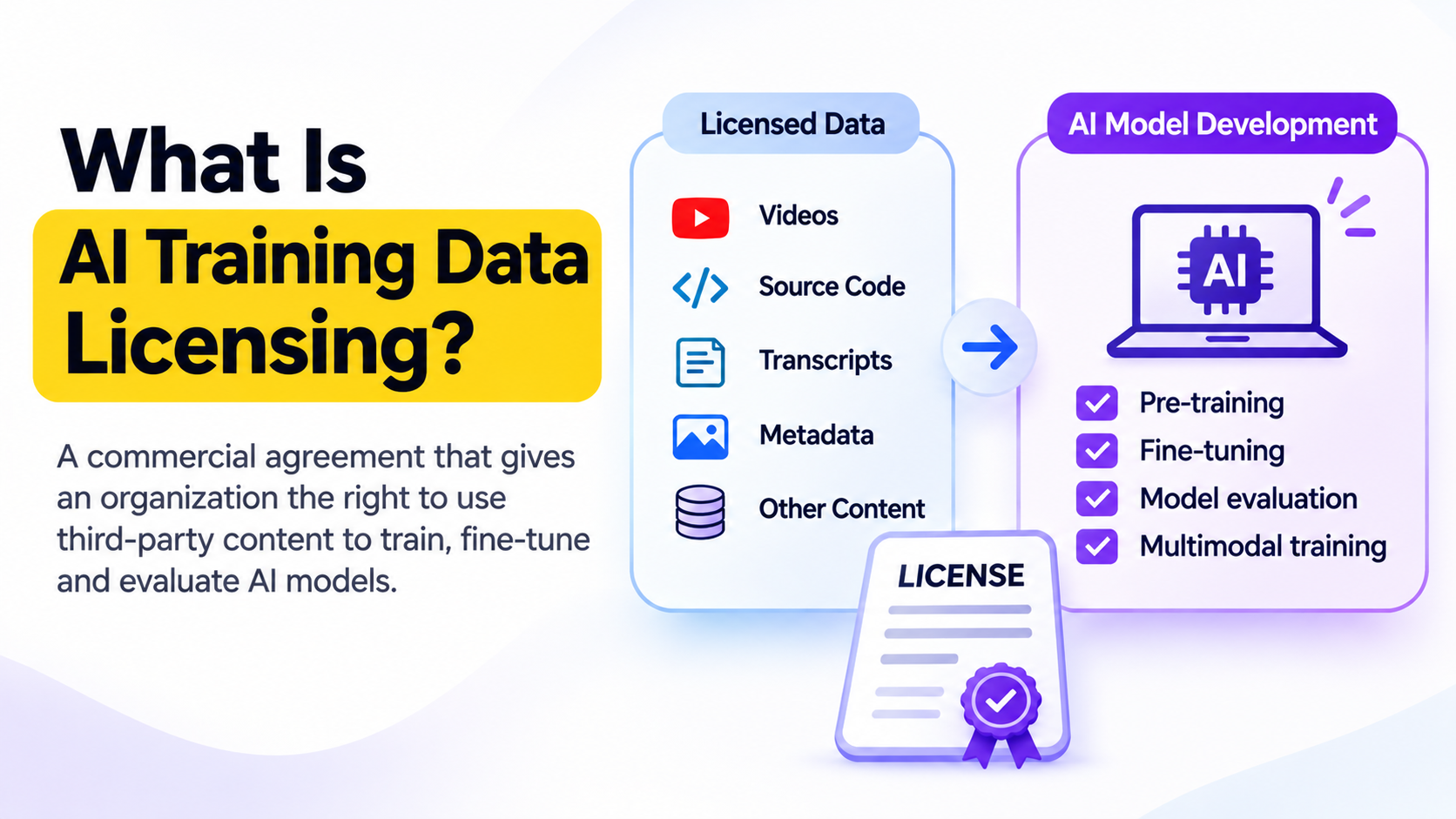
Depending on the agreement, licensed content may be used for:
- Pre-training and continued pre-training of LLMs.
- Supervised fine-tuning (SFT).
- Instruction tuning and preference optimization.
- Multimodal model training.
- AI agent development.
- Model evaluation and benchmark creation.
- Retrieval-augmented generation (RAG).
- Research and experimentation.
Rather than acquiring ownership of the underlying content, an AI company obtains permission to use it within an agreed scope, duration and territory.
For content owners, licensing creates an opportunity to generate revenue from existing intellectual property while retaining ownership.
For AI developers, it provides access to additional data sources without having to create every dataset internally.
Why AI Companies Are Looking Beyond Traditional Text Datasets
Traditional language model training relies heavily on text. However, modern AI systems increasingly work across multiple modalities and real-world tasks.
Consider an AI engineering tutorial.
A single technical video can contain several interconnected information sources:
- Narration: A human explains a concept, describes decisions and communicates technical reasoning.
- Screen recordings: The viewer sees actual software, commands, interfaces and workflows.
- Source code: Working implementations demonstrate how concepts translate into executable systems.
- Transcripts: Spoken explanations become searchable and processable text.
- Metadata: Topics, frameworks, difficulty levels and timestamps provide additional context.
Together, these elements can provide a richer source of learning material than an isolated text document.
For example, a tutorial demonstrating how to build a RAG application can include the explanation, implementation, terminal output, debugging process and final result.
This type of material may be relevant to organizations developing coding assistants, technical AI agents, multimodal models and developer-focused LLMs.
What Types of Content Can Be Licensed for AI Model Training?
AI companies can source training material from multiple categories.
1. Technical educational videos
Educational videos contain explanations, demonstrations and real-world workflows.
Potential applications include:
- Multimodal AI training.
- Speech and video understanding.
- Technical instruction following.
- Software engineering assistance.
- AI-powered educational systems.
2. Video and transcript datasets
Video datasets paired with timestamped transcripts can provide aligned visual and textual information.
Potential applications include video-language models, speech understanding, multimodal retrieval and temporal reasoning.
3. Source code and software demonstrations
Code repositories associated with educational content can provide additional context about software implementations.
Potential applications include coding assistants, code understanding, debugging and developer agents.
4. Technical documentation and tutorials
Technical documentation, walkthroughs and engineering explainers can contribute domain-specific knowledge for model adaptation and retrieval systems.
5. Expert-created learning material
Original explanations and demonstrations from experienced practitioners can provide examples of how complex technical subjects are communicated and implemented.
The appropriate licensing rights and permitted uses depend on the individual content and agreement.
What Should AI Companies Look for in a Training Data Provider?
Not every publicly accessible dataset is suitable for commercial AI development.
AI teams evaluating potential data suppliers should consider several factors.
1. Content ownership and licensing rights
The provider should be able to establish its authority to license the content. The agreement should explicitly define whether AI training, fine-tuning, evaluation, redistribution and other intended uses are permitted.
2. Dataset quality
Content should be sufficiently clear, relevant and useful for the intended training objective.
3. Multiple data formats
For multimodal development, having video, audio, transcripts and associated metadata can be valuable.
4. Technical depth
Specialized technical material can help teams target specific domains such as software engineering, AI agents, machine learning and infrastructure.
5. Metadata and organization
A structured dataset catalog should make it possible to filter content by topic, duration, difficulty, technology stack and other useful attributes.
6. Evaluation samples
Buyers should be able to inspect representative samples before committing to a commercial licensing agreement.
7. Provenance and documentation
A reliable provider should be able to document content origins, ownership, licensing scope and relevant restrictions.
Where Can Companies Find Licensed AI Training Data?
Organizations sourcing AI training data can explore several channels:
- Dedicated AI training data providers.
- Commercial dataset marketplaces.
- Specialist content owners and publishers.
- Educational platforms and technical content creators.
- Research institutions and domain-specific data providers.
- Direct licensing agreements with organizations that own relevant intellectual property.
For AI buyers, the sourcing decision should be based on the actual content, quality, permitted use cases and commercial terms rather than simply the size of a dataset.
Direct licensing from content owners can also be useful when an organization needs specific domains, formats or content that is not readily available through existing dataset marketplaces.
AI Anytime: Licensed AI Engineering Content for Model Development
AI Anytime maintains a library of original, hands-on AI engineering tutorials that can be licensed for AI development and corporate learning.
The library includes more than 470 videos and 210 hours of technical content, accompanied by transcripts, linked code repositories and video-level metadata.
Unlike a generic text corpus, the library contains recorded engineering demonstrations in which concepts are explained and implemented on screen.
What does the AI Anytime content library cover?
| Content category | Videos | Hours |
|---|---|---|
| Agents and agentic AI | 117 | 40 |
| Builds, tools and frameworks | 83 | 38 |
| Local and open-source LLMs | 72 | 28 |
| RAG and retrieval | 56 | 28 |
| Multimodal AI | 59 | 24 |
| Fine-tuning and training | 30 | 17 |
| LLMOps and deployment | 29 | 12 |
| Concepts and crash courses | 13 | 9 |
| Talks and conversations | 15 | 20 |
Talks and guest conversations are licensed separately.
What does the dataset include?
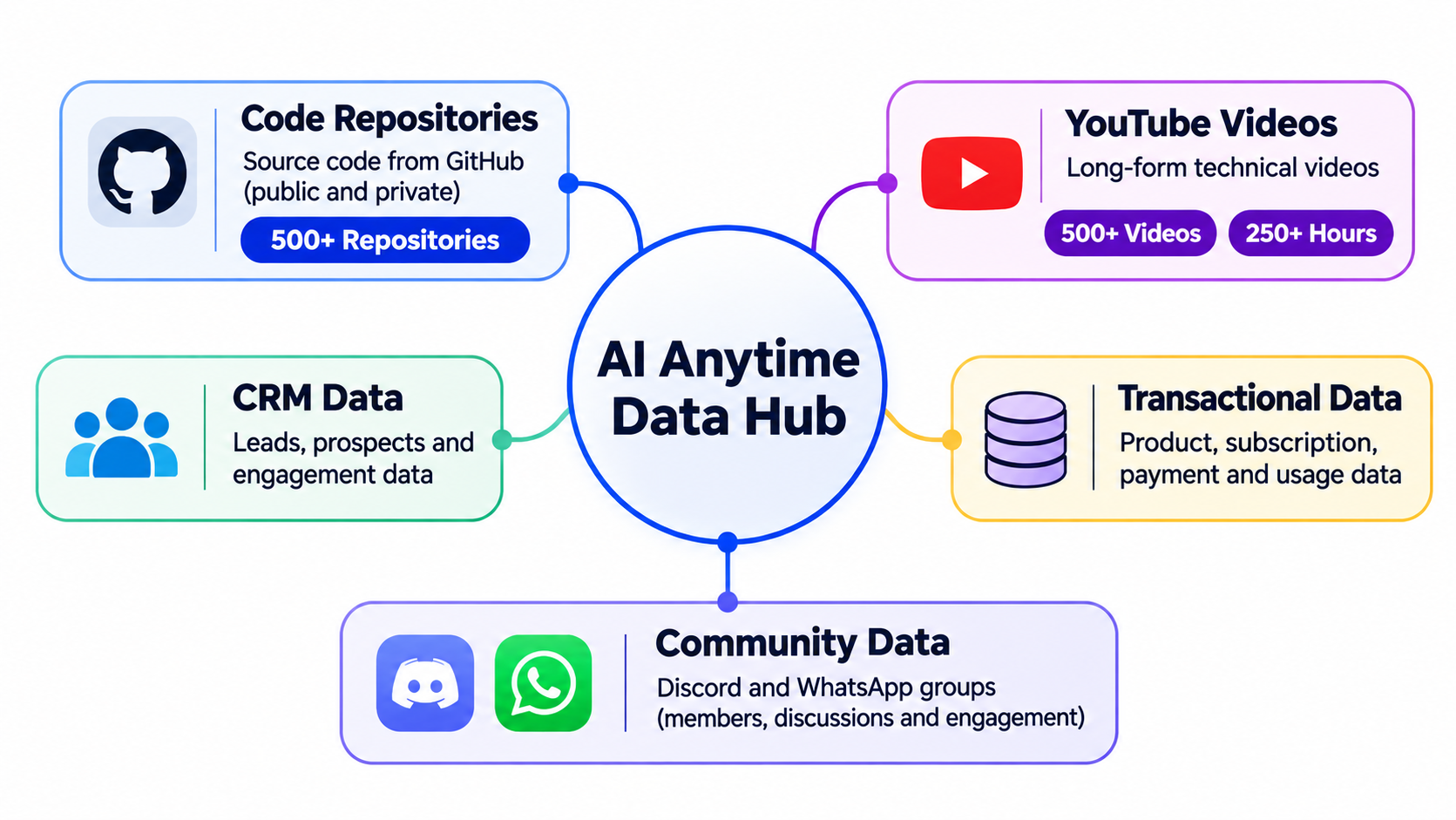
Depending on the selected licensing scope, AI Anytime provides:
- Original source video files.
- Timestamped and cleaned transcripts.
- Linked source code repositories.
- Video-level metadata.
- Topic and technology classifications.
- Content difficulty and runtime information.
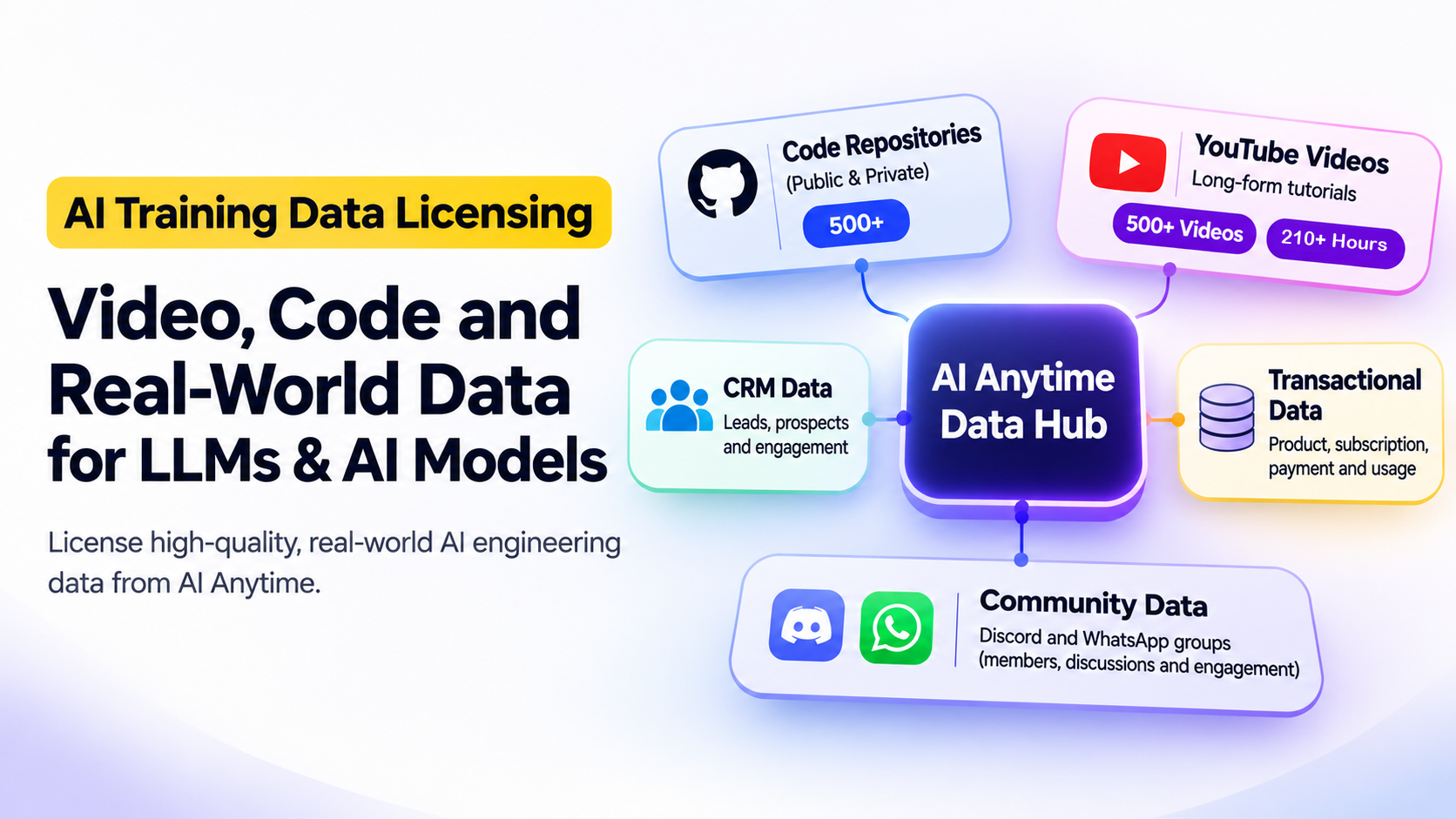
- CRM data.
- Transactional data.
- Discord/WhatsApp community data.
500+ GitHub Repositories: Real-World Code and Implementations
Alongside its video library, AI Anytime maintains a collection of more than 500 GitHub repositories, spanning both public and private projects. These repositories cover practical implementations across AI engineering, large language models, RAG pipelines, AI agents, machine learning, model fine-tuning, deployment, automation and related technologies.
The code repositories provide an additional layer of technical context to the educational content. Instead of offering only explanations of how AI systems work, AI Anytime can provide access to corresponding software implementations, project structures, configuration files and practical engineering workflows, subject to the applicable licensing scope.
For AI companies developing coding assistants, software engineering agents, technical LLMs and AI development tools, this combination of educational explanations and real-world code can be valuable for evaluating domain-specific training data.
The AI Anytime content ecosystem includes:
- 470+ original technical videos.
- 210+ hours of AI engineering content.
- 500+ GitHub repositories, including public and private projects.
- Video transcripts and associated metadata.
- Practical code implementations and project references.
Private repositories are subject to separate access and licensing permissions. Repository availability and permitted uses are defined by the individual licensing agreement.
Potential AI development applications
The content may be evaluated for several development workflows:
- LLM pre-training and continued pre-training.
- Supervised fine-tuning and instruction tuning.
- Video-language and multimodal model development.
- Technical knowledge and code understanding.
- Model evaluation and benchmark construction.
- AI agent and developer assistant research.
The suitability of individual assets depends on the buyer's training objectives and dataset requirements.
Flexible commercial licensing
AI Anytime offers licensing for the complete library, selected technical categories or individually curated collections.
Licensing terms can cover:
- Permitted AI development use cases.
- Selected content and total licensed hours.
- Licensing duration and territory.
- Non-exclusive or negotiated exclusive arrangements.
- Secure content delivery and dataset documentation.
AI Anytime retains ownership of its core content. Licensing is non-exclusive by default, with other arrangements available for defined scopes.
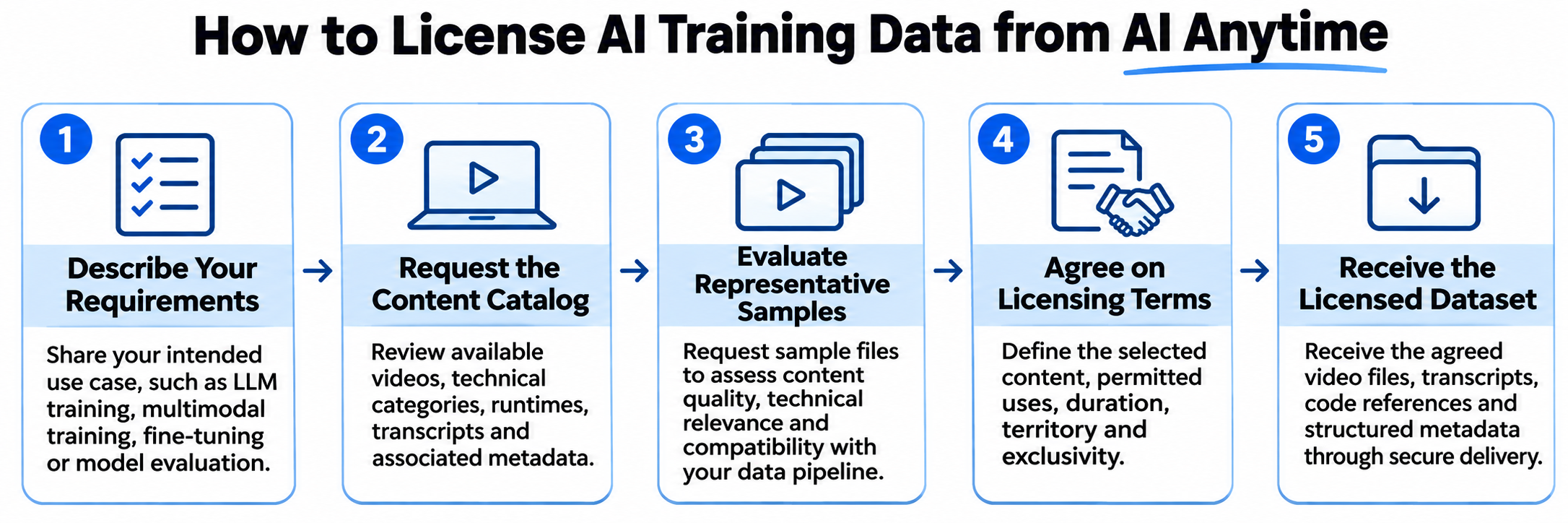
How to License AI Training Data from AI Anytime
AI companies and data procurement teams can follow a straightforward process:
Step 1: Describe your requirements
Share your intended use case, such as LLM training, multimodal training, fine-tuning or model evaluation.
Step 2: Request the content catalog
Review available videos, technical categories, runtimes, transcripts and associated metadata.
Step 3: Evaluate representative samples
Request sample files to assess content quality, technical relevance and compatibility with your data pipeline.
Step 4: Agree on licensing terms
Define the selected content, permitted uses, duration, territory and exclusivity.
Step 5: Receive the licensed dataset
Receive the agreed video files, transcripts, code references and structured metadata through secure delivery.
Frequently Asked Questions About AI Training Data Licensing
Where can I buy AI training data?
AI training data can be sourced from commercial dataset providers, data marketplaces, specialist publishers and organizations that own original content. Buyers should evaluate licensing rights, dataset quality, provenance and compatibility with their intended model-development workflows.
Can YouTube videos be licensed for AI model training?
Yes, individual content owners may offer separate commercial licensing agreements for their original videos, subject to their ownership and applicable rights. A YouTube video being publicly accessible does not automatically grant permission for commercial AI training.
What is the difference between LLM training data and fine-tuning data?
LLM training data can be used during initial or continued model training to develop language and domain capabilities. Fine-tuning data is typically used to adapt an existing model to specific tasks, behaviors or domains. The formats and requirements depend on the training methodology.
What are multimodal AI training datasets?
Multimodal datasets contain multiple types of information, such as text, images, audio and video. These datasets can help develop models that understand and process information across different modalities.
Do AI companies need to license data for model training?
Companies should establish that they have the necessary rights and permissions for their intended data use. Commercial licensing is one way to obtain clearly defined usage rights from content owners.
Can educational videos be used for LLM training?
Educational videos can be considered as potential sources for AI training, particularly when accompanied by transcripts, metadata and associated materials. The usefulness depends on the model objective, data preparation and licensing permissions.
Does AI Anytime sell or transfer ownership of its videos?
No. AI Anytime retains ownership of its core content. Customers receive commercial usage rights under an agreed licensing arrangement. Non-exclusive licensing is the default.
Can companies license only selected AI tutorial videos?
Yes. Organizations can request licensing for the full library, selected technical categories or curated collections, depending on their requirements.
Looking for Licensed AI Training Data?
If your organization is developing large language models, multimodal AI systems, coding assistants or AI agents, access to relevant and properly licensed technical content can expand your available training data sources.
AI Anytime offers a growing library of original AI engineering videos, transcripts, code references and structured metadata for organizations interested in AI training data licensing.
Request the AI Anytime content licensing catalog.
Explore the available content, evaluate representative samples and discuss licensing terms for your AI development requirements.
Request the Content Licensing Catalog
AI Anytime — Practical AI for All.