Imagine opening your laptop and building an AI application that can answer questions, understand documents, automate tasks, or solve a real-world business problem. What once seemed like something only advanced researchers could do is now becoming possible for people with the right technical skills and practical knowledge.
Artificial Intelligence is changing how we work, learn, communicate, and build products. Companies across industries are exploring AI to improve their operations, automate repetitive tasks, and create better customer experiences. As this technology becomes more common, the demand for people who understand how to build and implement AI solutions is growing.
This has made many students, fresh graduates, software developers, and working professionals ask an important question: How to become an AI engineer? What should you learn first? Do you need a computer science degree? Which programming languages and tools should you know? And how do you move from learning concepts to building real AI applications?
If you are also trying to find answers to these questions, this guide will help you understand how to become an AI engineer in 2027 through a practical, step-by-step learning roadmap.
Why Are More People Interested in Becoming AI Engineers?
AI applications can answer customer questions, summarize documents, recommend products, and automate business tasks. Building these solutions requires more than using an AI chatbot. It requires people who understand programming, data, AI models, and software development. This is where AI engineers come in.
What Is an AI Engineer?
An AI engineer builds applications using Artificial Intelligence. They work with programming languages, machine learning models, Large Language Models (LLMs), APIs, and databases.
Their responsibilities include building chatbots, developing AI agents, creating RAG applications, testing models, and deploying AI-powered products. In simple terms, they turn AI technology into useful applications.
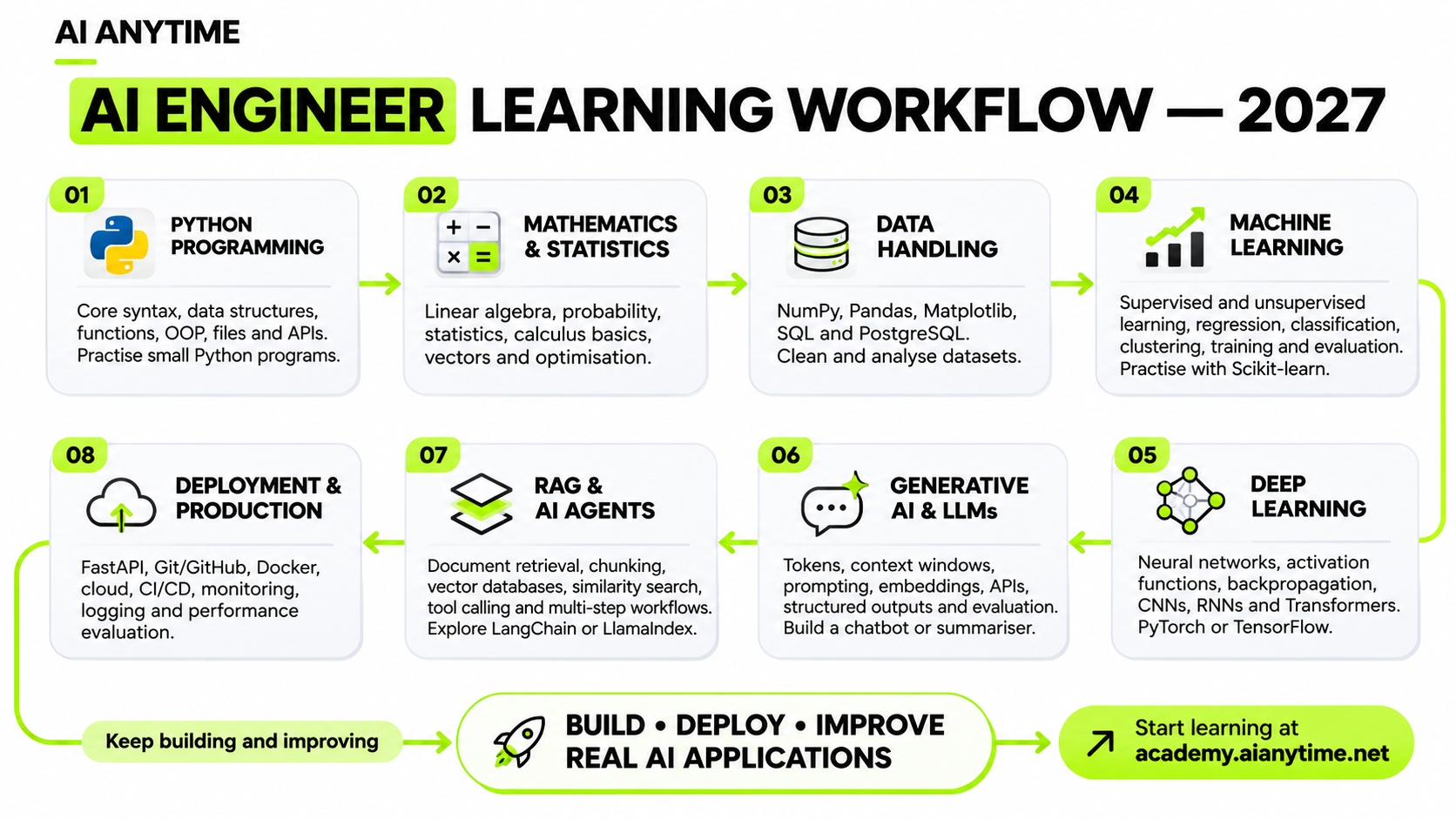
How to Become an AI Engineer: Step-by-Step Roadmap for 2027
The accompanying eight-step infographic explains the learning journey, from Python and mathematics to machine learning, Generative AI, RAG, AI agents, and deployment. Use it as a visual guide to understand what to learn and in what order.
What Projects Should You Build to Become an AI Engineer?
Learning theory is not enough. Build projects that demonstrate your skills.
- AI chatbot: Answer questions using an LLM API.
- Document assistant: Let users upload PDFs and ask questions.
- AI resume analyser: Compare resumes with job descriptions.
- Recommendation system: Suggest products based on user preferences.
- AI research assistant: Collect information and prepare summaries.
- Multi-agent application: Use multiple agents to complete a task.
Publish your projects on GitHub with screenshots and clear documentation. A few complete projects can demonstrate your abilities better than many unfinished ones.
Which Tools and Technologies Should an AI Engineer Learn in 2027?
| Skill area | Tools |
|---|---|
| Programming | Python |
| Data | NumPy, Pandas, SQL |
| Machine Learning | Scikit-learn |
| Deep Learning | PyTorch, TensorFlow |
| Generative AI | LLM APIs, Hugging Face |
| Application Development | FastAPI |
| RAG | LangChain, LlamaIndex |
| Deployment | Git, Docker, AWS, Azure |
You do not need to master everything immediately. Learn the fundamentals and practise with projects.
How Long Does It Take to Become an AI Engineer?
The timeline depends on your background and practice. A beginner may need 9–12 months or longer to develop strong foundations and build a portfolio. This is an estimate, not a job guarantee. Focus on what you can independently build and explain.
Can You Become an AI Engineer Without a Computer Science Degree?
Yes. A computer science degree is not compulsory for every AI engineering role. However, you need programming, mathematics, software development, and AI fundamentals. Practical projects can help demonstrate your skills.
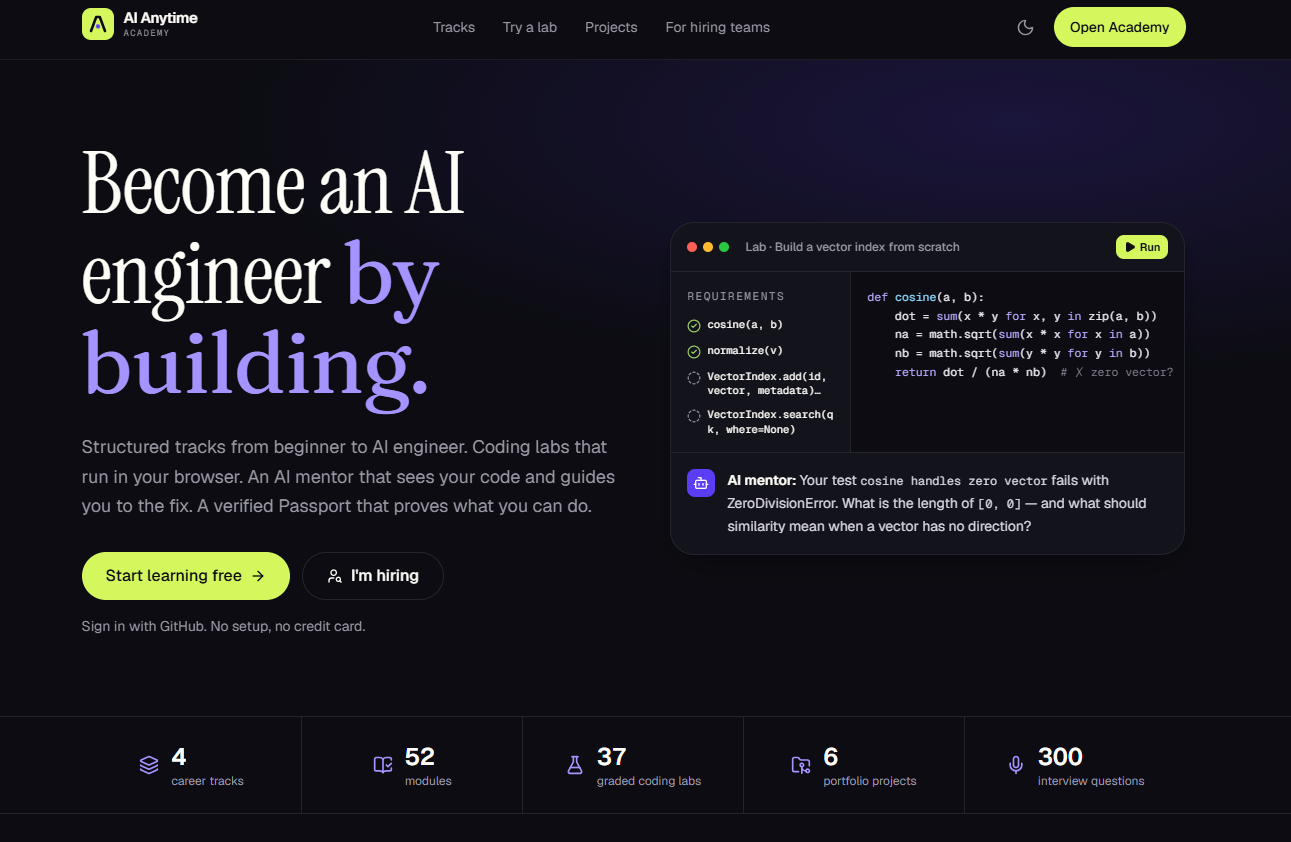
How AI Anytime Academy Helps You Learn AI Engineering Practically
Many learners struggle to choose what to learn, practise consistently, and turn theory into projects.
AI Anytime Academy helps learners explore structured tracks such as AI for University Students, Forward Deployed AI Engineer, AI Architect, and AI Generalist.
Its practical learning experiences include interactive coding labs, an AI-powered mentor, graded assignments, and portfolio projects. The goal is to help learners move beyond watching lessons and start building useful AI applications.
Frequently Asked Questions
Is Python necessary to become an AI engineer?
Python is widely used in AI development and is a strong starting language.
What skills are required to become an AI engineer?
Important skills include Python, mathematics, data handling, machine learning, deep learning, LLMs, RAG, AI agents, and deployment.
How many months does it take to become an AI engineer?
It depends on your background and practice. Many beginners should plan for 9–12 months or longer.
Start Your AI Engineering Journey Today
You do not need to learn everything on day one. Follow the roadmap, practise consistently, and build applications that solve real problems.
Ready to move from learning AI to building with AI? Explore the learning tracks and practical experiences at AI Anytime Academy and take your first step towards becoming an AI engineer.