AI Anytime Business · AI-Native GCC
Your GCC is about to be told to “do agentic AI.” Here is the strategy that survives the follow-up question.
Three hyperscalers now ship the same seven agent primitives. The internal agent platform your team was chartered to build in 2025 is now a purchase order. The opening is somewhere else.
In short
An AI-native GCC should not compete with the vendor ecosystem as a better AI builder. It should become the enterprise's Assurance & Autonomy Authority — the function that decides which agents may act alone, on what evidence, at what cost. AI Anytime's Assurance Layer playbook gives GCC leaders the argument, the operating model, the architecture and twelve templates to stand that function up.
The kit at a glance
- Format
- Playbook · toolkit · diagrams · deck · model
- Playbook
- 59 pages, 29 chapters, 6 parts
- Templates
- 12 fill-in instruments
- Research
- September 2026 · 19 sources, tiered
- Price
- $39 · the complete kit
The opening
A 61-point gap between autonomy granted and assurance trusted.
66%
of enterprises permit or are building unreviewed production deployment of agents
5%
fully trust the evaluations making their release decisions
50%
have shipped an agent that passed internal testing, then failed a customer
VB Pulse enterprise survey, June 2026, n=157, self-selected — the playbook names this as one of its two weakest load-bearing sources.
The argument
Building enterprise AI got cheap. Verifying it did not.
No vendor can tell a safety physician whether an agent's adverse-event triage was right, or tell a bank whether a KYC escalation would survive supervisory review. That judgment is domain labour — applied continuously, next to production, at volume.
In most global enterprises there is exactly one place where deep domain experts, production engineers and operational data sit in the same building at scale: the India centre.
So the move is to make the GCC the enterprise's Assurance & Autonomy Authority. The by-product is the moat — an evaluation corpus and failure taxonomy in your enterprise's own domain language. Unpurchasable. Non-transferable. Compounding.
Now commoditised — buy, don't build
- Runtime
- Gateway
- Memory
- Identity
- Observability
- Registry
- Orchestration
The same seven agent primitives shipped by AWS, Microsoft and Google between October 2025 and April 2026.
Inside the playbook · Chapter 7
Autonomy grades: the five rungs.
A grade attaches to an agent–process pair, expires on change, and is enforced at the gateway. Escalation is evidence-driven; a severity-1 failure drops the grade to G1 without a meeting.
- G0
Shadow
Runs against live inputs. Output logged and compared, never delivered.
Exit — 2 weeks live traffic · eval suite exists · baseline agreement rate recorded
- G1
Suggest
Output reaches a human as a recommendation. Accept, edit or reject becomes labelled data.
Exit — Agreement rate ≥ threshold · 500+ adjudicated cases · no severity-1 failures
- G2
Act with approval
Agent prepares the action; a human approves before it executes.
Exit — Override rate below threshold · 30 days of green regression runs
- G3
Act with sampling
Executes unattended; a statistical sample is adjudicated after the fact. Most value appears here.
Exit — Sampled error rate in tolerance for 90 days · rollback tested · cost per resolved task instrumented
- G4
Act unattended
Full autonomy in a bounded scope, monitored by anomaly detection rather than sampling.
Exit — Sustained G3 performance · blast radius bounded in policy · named accountable owner
What you get
Everything you need to run it, not just read it.
59 pages · 29 chapters · 6 parts
The Playbook
The full argument, the operating model, the technical architecture, the economics, the risk register, and the ten-question stress test the thesis has to survive before you present it.
12 fill-in templates
The Toolkit
Supplied as one printable file and as twelve separate PDFs, so you can hand one person one instrument.
6 diagrams · SVG + PNG
The Architecture Pack
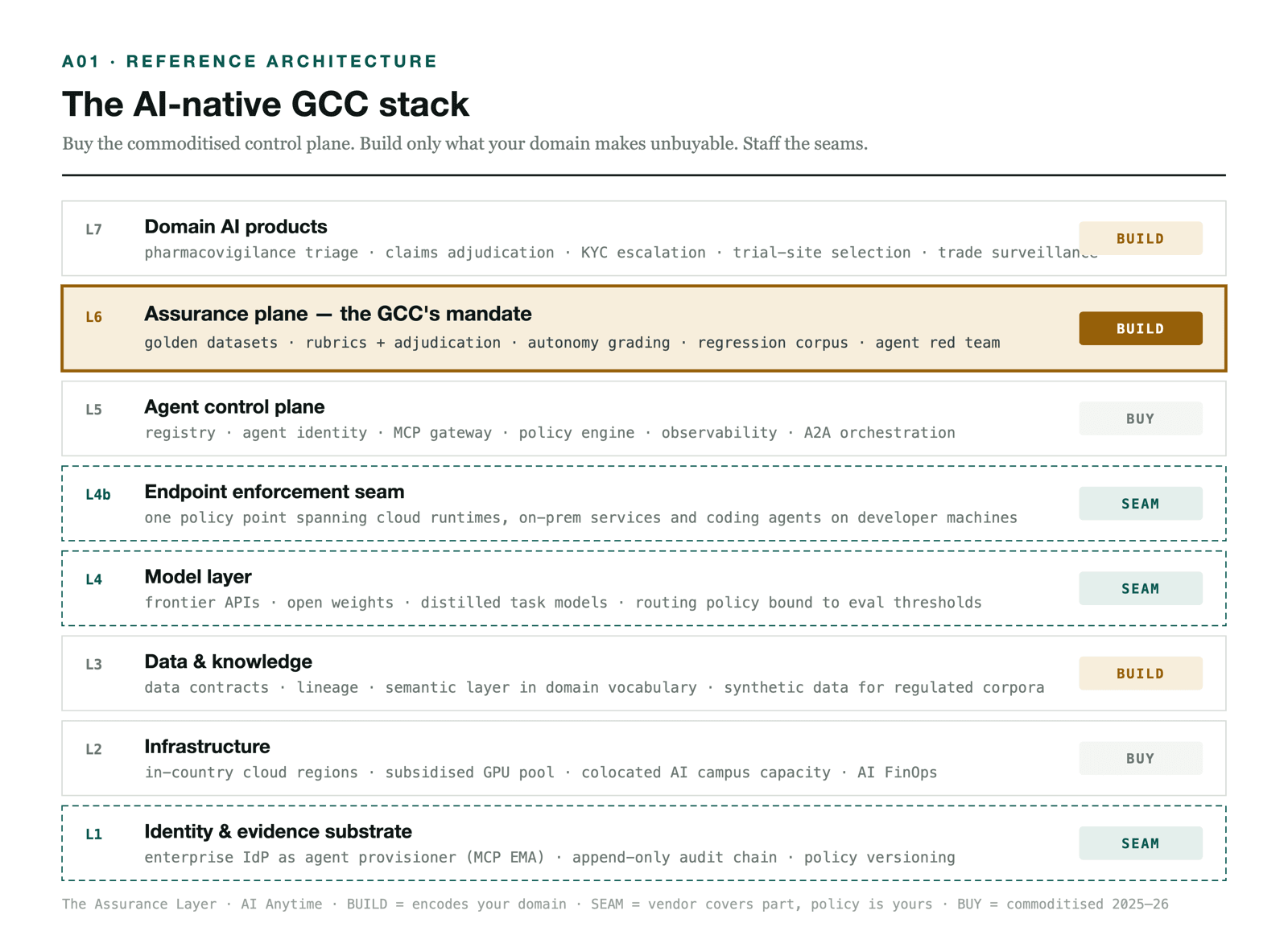
Reference stack with the build / buy / seam line drawn honestly, autonomy ladder, evaluation factory, decision rights, roadmap and Hyderabad capability map.
24 slides · 16:9
The Executive Deck
The whole argument for a leadership audience, with source tiers on every data slide.
CSV
The Business Case Model
Every assumption in an editable cell, with the three sensitivities you should test pre-wired.
The 12 templates
- Maturity assessment
- Autonomy grade rubric
- Release gate checklist
- Golden dataset charter
- Adjudication SLA + inter-rater reliability tracker
- Whitespace scoring matrix
- Build-vs-buy decision grid
- Agent risk register
- Cost-per-resolved-task spec
- 12 / 24 / 36 roadmap planner
- Business case model
- One-page board memo
Outcomes
What you can do on Monday.
- 01Score your own centre in 30 minutes on eight dimensions of assurance capability — and know which two are your year-one scope.
- 02Publish an autonomy grade scale — G0 shadow through G4 unattended — with evidence thresholds per task class.
- 03Run a build-vs-buy workshop on sixteen agent-stack components using a four-question sequence where the first “no” ends the discussion.
- 04Answer the four questions you will actually be asked: is this a renamed CoE, could a vendor provide it, what KPI changes, what becomes defensible?
- 05Put a one-page memo in front of an executive that names its own falsifier — which is what makes it read as analysis rather than advocacy.
Evidence standard
Why this is not another GCC market report.
Every claim carries a label
Observed, Inferred, Hypothesis or Speculation — so you know what you can quote in a board deck and what you have to test.
Weak sources are named
Chapter 27 identifies the two statistics carrying the most weight that come from self-selected samples.
Conflicts are shown
Hyderabad GCC counts range from 355 to 515 depending on what you count. The playbook says so instead of picking the flattering number.
The model says it's a model
No GCC's internal AI economics are public. The business case is labelled as constructed on the page it appears.
It downgrades its own ideas
Twelve whitespace hypotheses scored across ten dimensions — two explicitly downgraded by the stress test.
Who this is for
- GCC and centre heads who need a position that survives contact with group risk
- Heads of AI and AI CoE leads whose pilots are not converting
- Enterprise architects deciding what to build and buy in the agent stack
- Consultants and advisors to GCC leadership
- Anyone writing the AI section of a GCC's three-year plan
Not for you if
You want a vendor comparison, a model benchmark, or a GenAI use-case catalogue. Those exist in abundance and go stale in a quarter.
Research conducted September 2026 across nineteen sources. Regulatory dates — EU AI Act high-risk enforcement, MCP Enterprise-Managed Authorization, India's DPDP phasing, RBI FREE-AI — are primary-sourced. Market structure comes from nasscom–Zinnov and JLL. Regulation changes: verify current obligations with qualified counsel.
Get the kit
The complete kit. One price.
Everything you need to run it, not just read it.
The Assurance Layer · complete kit
$39
- Playbook (59 pp)
- 12 templates
- 6 architecture diagrams
- 24-slide executive deck
- Business case model
What is an AI-native GCC?
An AI-native global capability centre is one designed around AI agents as part of the workforce — not one that merely adopts AI tools. The Assurance Layer playbook argues its defining function is assurance: deciding which agents may act alone, on what evidence and at what cost.
What is the Assurance & Autonomy Authority?
It is the function the playbook proposes the GCC should become: the enterprise body that holds the release decision for agents, grades their autonomy per process, runs the evaluation factory and owns the domain failure corpus. Unlike a CoE, it holds a gate enforced at the agent gateway.
What are autonomy grades G0–G4?
A five-rung ladder for agent–process pairs: G0 Shadow, G1 Suggest, G2 Act with approval, G3 Act with sampling and G4 Act unattended. Each rung has explicit exit evidence; a severity-1 failure drops the grade to G1 automatically.
Should a GCC build its own agent platform?
Mostly no. AWS, Microsoft and Google now ship the same seven agent primitives — runtime, gateway, memory, identity, observability, registry and orchestration. The playbook recommends buying the control plane, building only what your domain makes unbuyable, and staffing the seams.
Is this India-specific?
The operating model, architecture and templates are geography-neutral and work for any enterprise standing up an assurance function. Part VI makes the India and Hyderabad case specifically, and states where that argument does not hold — for example, if you need 400 frontier ML researchers, Bengaluru leads.
Will this be updated?
Yes. Corrections and counter-evidence improve the next edition. Chapter 27 lists exactly what would change it.
Is it AI-generated slop?
It is an evidence-labelled research document with tiered sources, shown conflicts, downgraded hypotheses and a business model that flags itself as constructed. Judge it on Chapter 27 — that is where a brochure would have nothing to say.
Can AI Anytime help us implement it?
Yes. AI Anytime Business runs GCC leadership workshops on the playbook, helps stand up the assurance function and evaluation factory, trains GCC teams on agentic AI, and provides AI architects and forward-deployed engineers.
Beyond the playbook
Stand up your GCC's assurance function with us.
- Leadership workshop on the playbook for your centre
- Maturity assessment and year-one scope
- Evaluation factory and autonomy grading, set up
- Agentic AI training for GCC teams
- AI architects and forward-deployed engineers
See also AI Staffing and AI Training & Enablement.